
Blooming
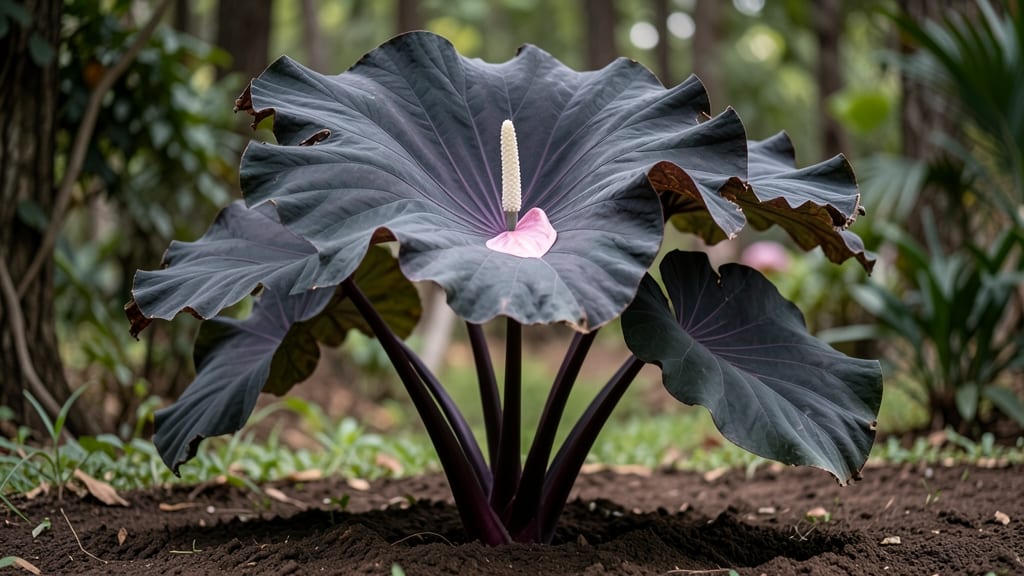
Elephant ears do bloom flowers, though their stunning foliage remains the star attraction. These tropical plants typically produce tall, slender spikes of small, often overlooked blooms in late summer or early fall, with some varieties reblooming each year when given optimal growing conditions.
While the dramatic, heart-shaped leaves steal the show, elephant ears (both Colocasia and Alocasia varieties) do produce flowers that serve an important purpose in their life cycle. 🌸 These blooms emerge from the plant's center as tall, arrowhead-shaped spikes, often in shades of white, pink, or purple, though they're rarely as showy as the foliage.
The flowering process depends heavily on maturity—young plants may take 2-3 years to bloom, while established specimens often reward gardeners with annual or even seasonal reblooms if provided with rich, well-draining soil and consistent moisture.
What makes these flowers particularly interesting is their dual role: they serve as both a reproductive mechanism and a visual bonus for patient gardeners. The blooms typically last just a few days before fading, but their presence signals the plant's health and readiness for potential propagation.
For those hoping to encourage more frequent flowering, maintaining consistent care—especially during the late summer growing season—can make a noticeable difference in reblooming frequency.
💡 In This Article
- Understanding Elephant Ear Flowering Mechanics
- Encouraging Elephant Ear Reblooming for Gardeners
Understanding elephant ear flowering mechanics
Elephant ear flowering is primarily triggered by a combination of day length and temperature thresholds. These tropical plants rely on short-day photoperiodism—meaning they detect decreasing daylight hours (typically 12 hours of light or less) as a signal to initiate bloom production.
This usually occurs in late summer when days begin shortening, often between August and October in temperate climates. The process also requires soil temperatures above 65°F, which is why tropical varieties may bloom later or not at all in cooler regions.
There's a fascinating biological trade-off here: elephant ears prioritize foliage growth over flowering because their massive leaves are their primary energy producers through photosynthesis.
The plant's energy budget is heavily skewed toward leaf expansion—those iconic heart-shaped leaves can reach 2 feet wide—which leaves limited resources for flower development. Colocasia varieties (like 'Black Stem' or 'Illustris') tend to produce more robust blooms than Alocasia species, which often focus even more on foliage.
The flowers themselves are typically small (1-2 inches long), tubular, and arranged in dense spikes that emerge from the plant's center.
What's particularly interesting is how these flowers function biologically: they're pollinated by insects like bees and flies, but their primary purpose isn't seed production for most garden varieties—they're often sterile or produce non-viable seeds. This explains why you rarely see seed pods developing on ornamental elephant ears.
The blooms serve more as an energy drain that signals the plant's maturity rather than a reproductive necessity. 🌿 For gardeners, this means you can safely remove spent flower spikes to encourage the plant to redirect its energy back into leaf production for next season's growth.
The timing of flowering also reveals an evolutionary adaptation: these plants originate from tropical regions where consistent warmth and humidity create ideal growing conditions year-round. In temperate climates, the brief flowering window represents a compressed version of their natural life cycle.
Some varieties, particularly Alocasia species, may never bloom in cooler climates because they require more specific temperature and humidity combinations to trigger the flowering hormones (like gibberellins) that initiate bloom development.
Here's what most gardeners don't realize about elephant ear blooms: while they may seem insignificant compared to the foliage, their presence actually indicates the plant's overall health.
A robust flowering display suggests the plant has stored enough energy in its rhizomes (underground stems) to support both leaf growth and reproductive efforts.
The flowers' short lifespan (typically 3-5 days) is nature's way of conserving energy—once pollinated, the plant quickly sheds the blooms to focus on storing nutrients for winter dormancy or next year's growth.
For those curious about the visual contrast, elephant ear flowers often appear as delicate spikes emerging from the center of the plant's massive leaves. The blooms typically range in color from pale white to soft pink, with some varieties producing purple-tinged flowers.
While they lack the dramatic impact of the foliage, their presence adds a subtle textural element to the plant's overall appearance, creating a beautiful contrast between the coarse, veined leaves and the smooth, tubular flowers.